Monthly Archives: September 2026

The First Storm After Installation: What Should You Check on a New Bali Hut?

Bali hut roof

After the first storm following installation, check your new Bali hut’s thatch, frame, tie-downs and drainage for damage. That first heavy blow tells you more about how the build handles weather than a calm month ever could.

Most Australian backyards cop at least one strong squall soon after a build goes up, and fresh thatch settles during that weather. Georgia Wiseman sees the same pattern every season, so a slow walk-around within a day or two saves money later.

Honestly, the timing is rarely luck. Bureau of Meteorology records show an average of about 11 tropical cyclones forming in the Australian region each season, with roughly four of them crossing the coast.

This guide covers the checks that count, from ridge cap to ground drainage, plus a routine you can keep. Grab a ladder and start at the top.

Post-Storm Bali Hut Roof Inspection: What to Check First

A single missed tear in the thatch can let water pool inside the frame for weeks. Storm damage on a Bali hut roof rarely announces itself, so you’re hunting for small changes rather than obvious holes.

Post-Storm Bali Hut Roof Inspection: What to Check First

Work across the roof in three passes, starting with the broad surface and finishing with the bundles themselves.

Checking the Thatch and Roof Surface for Gaps and Thin Spots

Stand underneath first and look up towards the light, because daylight coming through the thatch marks every thin spot far better than any view from above.

From there, move outside and scan the roof surface for patches that look flattened or combed the wrong way (wind lifts the layers and drops them back wrong).

Press a gloved hand into any suspect patch. Sound thatch feels springy and dense, while a thinned section gives way under light pressure.

Spotting Damaged Thatch Near the Ridge Cap

The ridge cap sits at the highest point and takes the worst of the wind, which makes it the first place damaged thatch turns up after a storm.

Look for capping lifting at either end, plus any gap between the cap and the thatch running down each side. In our experience fitting huts across Australia, ridge failures start as a two-finger gap and widen quickly.

Here is the thing. That seam sits directly over the ridge beam, so water entering there runs straight into the frame instead of shedding off the roof.

Are Any Thatching Bundles Loose or Missing?

Yes, storms do pull bundles loose, and you’ll spot them as dark gaps or as tufts hanging below the clean line of the roof.

Tug gently on a few bundles along the lower edge, where the binding wire carries the most load during strong gusts. Missing bundles leave the row above them exposed, so the damage spreads with every shower that follows.

Mark each loose one with a peg or tape so your repair crew works from a list rather than guessing (tape beats memory every single time).

Frame and Tie-Down Checks for Bali Huts Across Australia

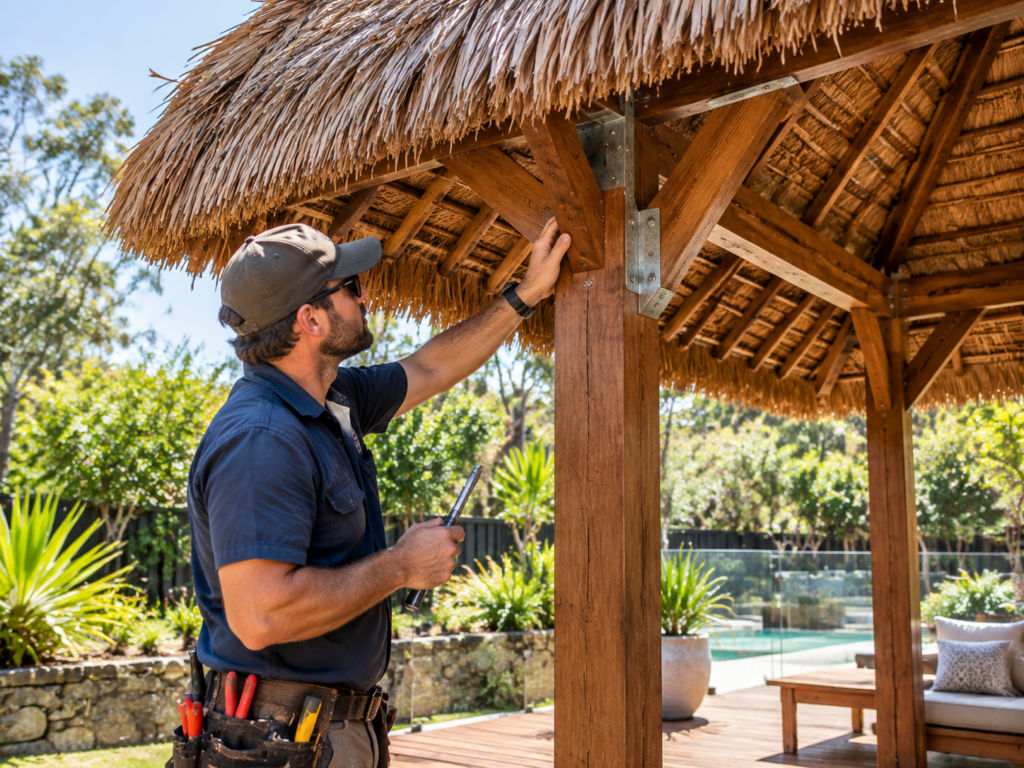
With the thatch sorted from the ground up, solid tie-downs keep the whole structure steady through the next big blow. Every Bali hut Australia-wide pushes that wind load down through the frame sitting under its thatched roof. Gazebos, Bali huts and pergolas all shift in the same way.
Frame and Tie-Down Checks for Bali Huts Across Australia

Run through these four points before you pack the ladder away.

  • Post Bases and Bolts: Rust streaks or a bolt that turns freely by hand point to movement during the storm, so tighten each one and recheck it a week later.
  • Cyclone Strapping: Check every galvanised strap where it wraps the rafter, because a bent or stretched strap has already taken a hit you cannot see from the lawn.
  • Fresh Rafter Splits: Splintering in the timber around screw holes tells you the joint flexed further than the fixing was ever meant to allow.
  • Ground Anchors: If your hut sits on soft lawn, soil around the footing washes out and leaves the post standing in a shallow pocket.

Tighten what you can reach with the right tools, and photograph anything you cannot. Those photos give an installer real information before anyone quotes a repair.

Why Does Water Pooling Signal a Drainage Problem for Your Thatched Roof?

Water pooling around a Bali hut signals a drainage problem because rain cannot drain away fast enough. Thatch sheds a surprising volume in a short burst, and all of it lands in a ring around the posts.

Ground takes the hit before anything else does. Clay soils across much of Australia hold that water for days, and flat Brisbane blocks drain slower again, which softens the base of every post sitting in them.

Conditions shift with the postcode, too. Humid stretches on the Central Coast keep the lowest thatch damp for weeks, while in South Australia, Adelaide sheds water fast and then bakes the timber dry. Thatched builds in New Zealand sit somewhere between the two.

Beyond the posts, standing water keeps the lowest row of thatch damp long after the sky clears. Damp thatch at ground level rots from the bottom up, and that row holds the rest of the roof edge in place (the cheapest row to save, too).

Every Bali hut inspection we run after a wet week starts with a bucket tipped at the base of a post. Bottom line: if the water sits still for a minute, you want a fall of 50 mm over the first metre, or a shallow gravel trench leading away.

Building a Simple Thatched Roof Maintenance Routine for Australian Huts

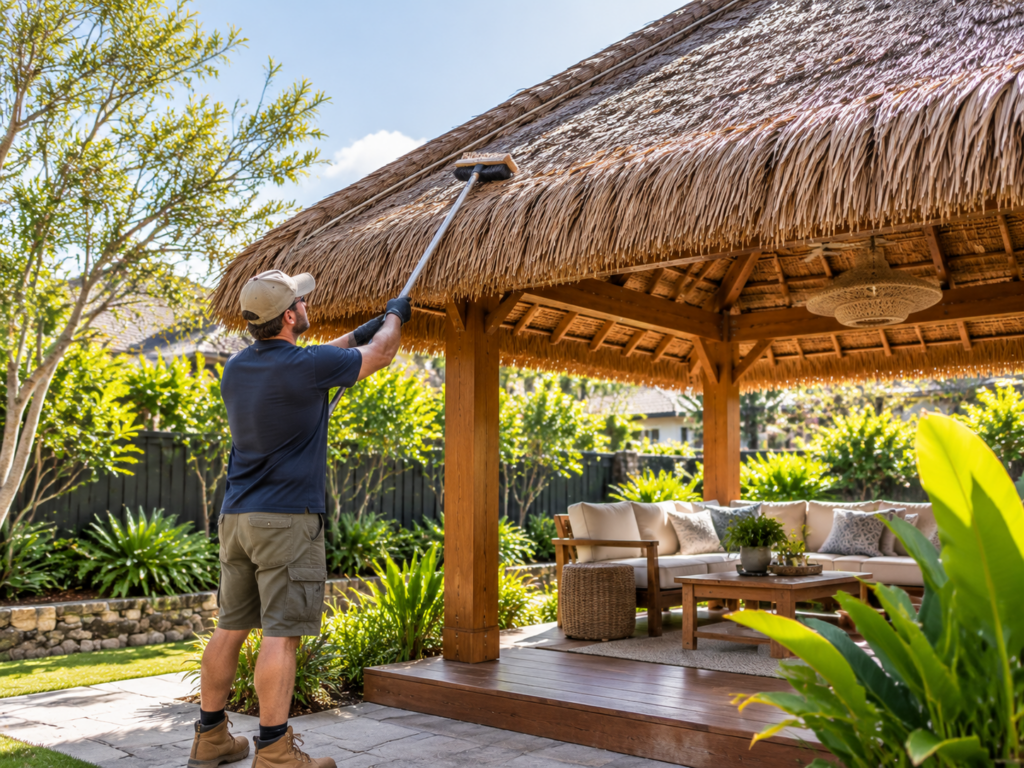
Once the roof and frame are checked, a simple routine keeps them that way. Regular thatched roof maintenance takes a few hours a year and keeps the thatch going well past a decade.
Building a Simple Thatched Roof Maintenance Routine for Australian Huts

This schedule suits most Australian homes.

WhenWhat to doWhy it helps
After each stormWalk the roofline, check ridge and postsCatches small tears early
Twice a yearClear leaves and debris from the thatchStops damp patches forming
YearlyRetighten bolts, straps and anchorsKeeps the frame rigid
Every 8 to 12 yearsBook a full re-thatchGives you a new roof of fresh thatch

Worth noting: huts under gum trees need clearing twice as often. Keep a photo from each check so you can track how the thatch ages.

Keep Your New Bali Hut Ready for the Next Australian Storm

A first storm exposes weak points while they’re still small and cheap to fix. Twenty minutes with a ladder and a torch protects a structure built to last years.

Put the next check in your calendar before you climb down, because the habit does more good than any single Bali hut inspection. Photograph anything you’re unsure about and send it through for a second opinion.

Georgia Wiseman offers re-thatching and repair services for gazebos, Bali huts and pergolas across Australian backyards. Contact us for a post-storm check of your roof.

Read More

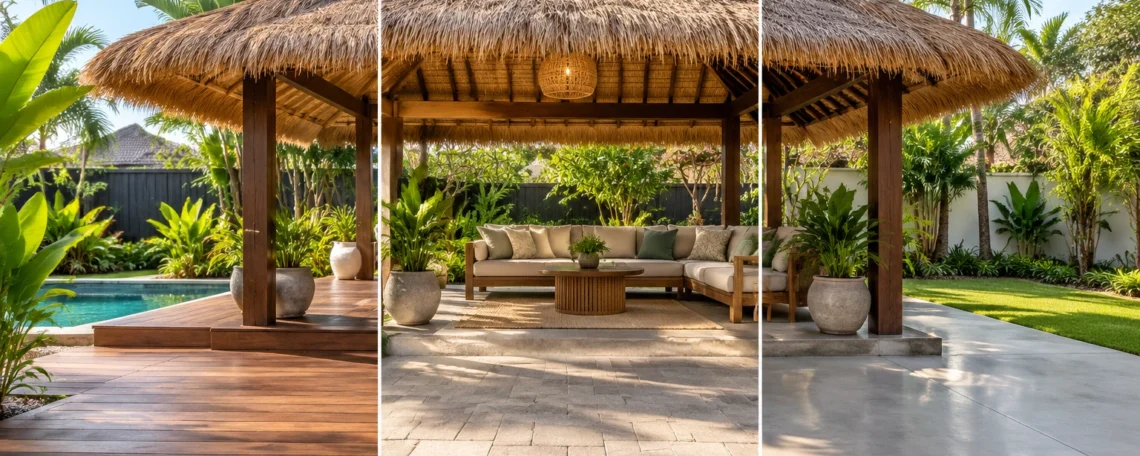
What Should Sit Under a Bali Hut: Decking, Pavers or Concrete?

Your Bali Hut Flooring Choice

Decking, pavers, or concrete: the base you choose determines how your Bali hut flooring drains, supports furniture, and weathers over time. Get this choice wrong, and you’ll spend more time fixing your base than relaxing in the shade on a hot day.

We’ve helped plenty of homeowners work through this exact decision. More often than not, the yard does most of the work, since clay soil, steep slopes, and poor drainage each push you toward a different base before budget or style even enters the picture.

To give you a clearer picture, this article covers what each base involves and which yard conditions suit it best. After that, we’ll show you how your own block points toward the right pick.

Let’s get into it.

Timber Decking: The Elevated Option for Airflow and Style

Oiled timber decking enhances your Bali Hut look

Many homeowners pick decking first, drawn to its warm, natural finish. A stained or oiled surface enhances the look further and brings real benefits in terms of weather protection too.

Beyond the look, raised decking lifts your Bali hut off the soil so air moves freely underneath and moisture stays away from the timber beneath. It works much like a verandah floor that way.

And that’s just the start. It earns its spot as a base choice for a few other reasons too.

  • Moisture Stays Out: As we mentioned, raising your Bali hut off the earth stops moisture from collecting against the structure. We’ve seen posts rot within two years when a base sits too low.
  • Gaps Handle Rain: A small gap between each board, usually 4mm to 6mm, gives rainwater somewhere to go instead of pooling on top. Without that spacing, water has nowhere to go and starts pooling around your posts instead.
  • Easy Annual Upkeep: Once installed, a quick coat of decking oil once a year keeps the timber protected. Most households get 15 years or more out of a well-maintained deck.

For backyards that get regular rainfall, that drainage advantage makes decking the lowest-risk base choice for your own Bali hut over a 10 to 15-year period.

Bali Hut Pavers: A Popular Middle-Ground Option

Unlike decking, pavers are flat stone or concrete tiles laid directly on the soil, with no raised framing or annual resealing required. So if you’re after a neat, flush outdoor space where family and friends can relax without the ongoing work, this option is a fantastic choice to consider.

Low maintenance is only part of it, though. Pavers lay completely flat underfoot, which means heavier pieces like stone tables and fire pits don’t rock or need re-levelling. Pavers handle both stability and drainage without sacrificing one for the other.

The drainage side is just as practical. Small joints between each paver pull rainwater down through the base rather than letting it collect near your posts. A dry base means less moisture pressing against your Bali hut’s frame, which reduces rot risk over time.

Beyond drainage and stability, style flexibility is another advantage worth noting. Pavers come in a range of materials, including natural stone, concrete-look tiles, and terracotta finishes. That variety means you can create a style that adds charm to your existing backyard without redesigning anything around it.

In our experience, pavers suit the widest range of backyards simply because the soil preparation is minimal and the overall cost is more affordable than concrete. Pavers suit the widest range of backyards simply because the soil preparation is minimal and the overall cost sits well below a concrete pour.

Can You Pour a Concrete Base for a Bali Hut?

Heavy-duty base, concrete gives your Bali hut a solid, level surface

Yes, and for backyards that need a permanent, heavy-duty base, concrete is in a different league entirely. It locks into the soil and gives your Bali hut a solid, level surface without shifting or settling. A good contractor with great service makes sure it stays that way.

The main catch is the installation process. Concrete needs proper base preparation before pouring, since soil movement beneath a slab can cause cracking if the groundwork is rushed.

That complexity aside, the slab has a few clear strengths that make it worth considering.

  • Built for Weight: Concrete supports more weight than decking or pavers. While pavers handle standard outdoor furniture and smaller fire pits, a large built-in barbecue, spa surround, or full stone lounge setting needs the load capacity only a slab provides.
  • Almost Zero Maintenance: Once a professional seals the slab after pouring, concrete needs little more than an occasional hose down. Unlike timber, there’s no recoating, resealing, or annual maintenance schedule to follow.
  • Not a DIY: The area beneath needs proper preparation and levelling before you pour a slab. Skip that step, and you won’t be able to anchor the structure properly, which leads to cracking within the first few years.

Concrete delivers the most durability of the three options, but it asks the most of you upfront. If you’re planning a permanent outdoor space around your Bali hut, that trade-off is usually worth it.

Let Your Soil and Slope Decide the Base

Testing the soil and slope before deciding on the base

Your soil type determines how water drains after rain, and your slope determines where that water travels next. Together, they narrow three options down to one before you spend a cent on materials.

In practice, most Australian backyards fall into one of three categories.

  • Clay Soil Risk: Clay holds water for hours after rain and shifts slightly as it dries, which makes concrete a risky choice. Meanwhile, pavers or decking handle the drainage demand without the cracking risk.
  • Slope Limits Options: Unlike flat ground, a significant slope rules out pavers without serious regrading first. Decking handles slope better since the frame can be adjusted to level during installation.
  • All Options Open: Where clay and slope narrow the field, flat ground with sandy soil gives all three bases a fair chance. Your decision then comes down to budget, style, and how much upkeep you’re willing to commit to.

If your soil type isn’t obvious from the surface, a quick test kit from your local hardware store costs under $20. That result alone tells you where your yard stands before you commit to any stylish outdoor structures.

Installing Your Bali Hut Base: What to Expect

Expect soil and ground preparation, levelling, and framing for all three bases, but the time and effort each installation involves varies significantly. Concrete falls at the far end of that range, and in our experience, it needs the most patience to get right.

Before you book anyone in, this breakdown shows what each base demands.

Base

Process

Timeframe

DIY Friendly?

Decking

Posts, levelling, boards

1–2 days

Yes

Pavers

Compacted base, laying, levelling

1 day

Yes

Concrete

Professional pour, curing

3–7 days

No

What the table doesn’t capture is the hidden cost of getting it wrong. A rushed concrete pour can mean cracking within two years, while a poorly compacted paver base leads to uneven surfaces that are expensive to relay.

Decking is the most forgiving of the three since individual boards can be detached and replaced without rebuilding the whole frame. Over time, boards show wear. But most DIY installs need only basic tools, including nails and a level, to complete the job.

One Last Thing Before You Pick a Base for Your Outdoor Space

Most Bali hut owners think about the thatched roofing, the structure, and the style. The base rarely gets the same attention, and that’s where things go wrong. A poor base choice reveals itself in drainage issues, unstable furniture, and repair bills that could have been avoided entirely.

In this guide, we walked you through each base option, what installation involves, and how your soil and slope narrow the choice. You should now have a clear starting point before anything gets ordered or booked.

Our team at Georgia Wiseman has helped hundreds of Australian homeowners land on the right base for their yard, budget, and lifestyle. Contact us today, and we’ll walk you through local council regulations, your property’s council approval, and more.

Let’s get your beautiful Bali hut built properly, and enjoy the beauty of a well-chosen base for years to come.

Read More

Can You Move a Bali Hut? What to Check Before Relocating an Existing Structure

Can You Move a Bali Hut

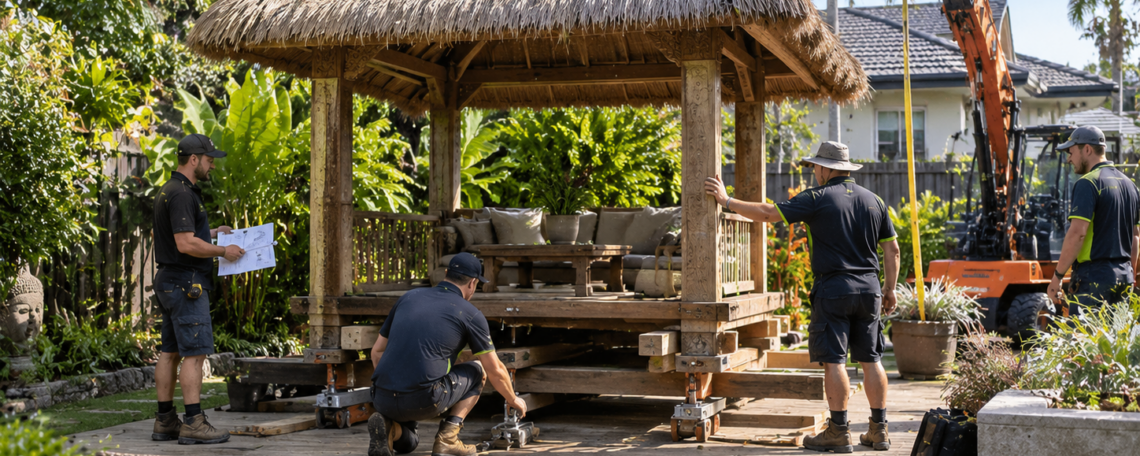
You can move a Bali hut if the frame and thatch roof are still strong enough to be taken apart and rebuilt. Their condition will affect the work involved and the total cost.

However, most owners only consider moving a Bali hut after a renovation, pool project, or house sale makes the decision necessary. By then, the hut may have spent years exposed to Australian weather, which can affect whether it’s suitable for relocation.

The truth is, relocation is nothing but a second Bali hut installation, just with used parts. So in this guide, we’ll cover the checks worth doing first, the real cost of each path, and the point where a new build wins.

What Should You Check Before You Move a Bali Hut?

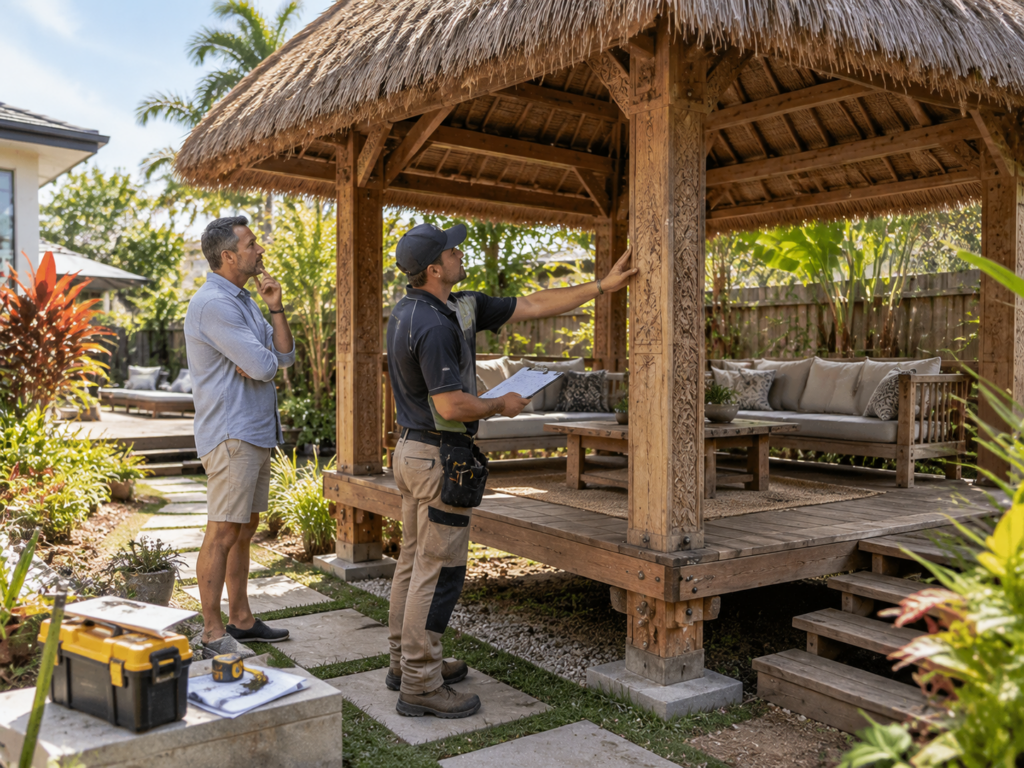
Before you move a Bali hut in Australia, check the frame, thatch roof, pole spacing, and your council rules. Any one of these can stop the move, so check them all before you start.

What Should You Check Before You Move a Bali Hut?

While you’re at it, run these checks before you book a truck or pull a pin from the roof:

  • Frame and Pole Condition: Check the posts for cracks, rot, or termite damage before planning the move. Damaged posts may not hold up during a second build. So tap each pole and inspect the base where it meets the ground. Also, measure the distance between the poles because the new footings need to match the existing layout.
  • Thatch Roof Wear: Natural thatch older than eight to ten years often needs replacing. These older, dry reeds can break apart when you remove them from the battens, which makes them unsuitable for reuse.
  • Council Permits: Many councils treat a moved hut as a new structure and ask for fresh approval, especially near boundaries, pools, or an easement.
  • New Site Preparation: Level the new ground before installing the hut. Then check that water can drain away and that there’s enough space around the poles and wide eaves. You might also want to consider how much wind the site gets, as an exposed area puts more pressure on the hut than a sheltered space.

Now, permits aren’t always required, but the rules depend on the hut’s size, location, and the type of development approval that applies.

In NSW, the State Environmental Planning Policy (Exempt and Complying Development Codes) 2008 sets the rules for exempt development. It allows some gazebos up to 20 square metres in rural and large lot residential zones to qualify. The limit is 15 square metres in most other zones, provided the structure meets the other requirements.

Larger structures may need approval, and each state has its own rules.

Frame and Pole Condition Decide Whether a Bali Hut Relocation Will Work

Relocating a Bali hut frame without checking its condition can lead to extra repair costs. Timber and thatch also age differently, so each material needs a separate inspection.

That’s why when you search “Bali hut Australia”, you’ll find plenty of builders who’ll sell you a new one. Far fewer will move an old one (and that tells you something).

So work through the three checks below before you lock in a date with anyone.

Testing the Poles and Joints for Rot or Cracking

Start at the base of each pole, where ground moisture can cause the most damage. Push a screwdriver about 20 mm into the timber above the footing. If the blade sinks in with light pressure, the timber has become soft and may not survive removal.

This kind of damage can be difficult to see because the outside of the pole may still look solid. We’ve stripped down huts where three of six poles crumbled at the base (not that you could tell from the back deck).

The rest of the frame needs the same attention. Check the top joints for rusted bolts and brackets, as these connections can weaken before the timber itself shows major damage.

Are DIY Kit Bali Huts Easier to Relocate?

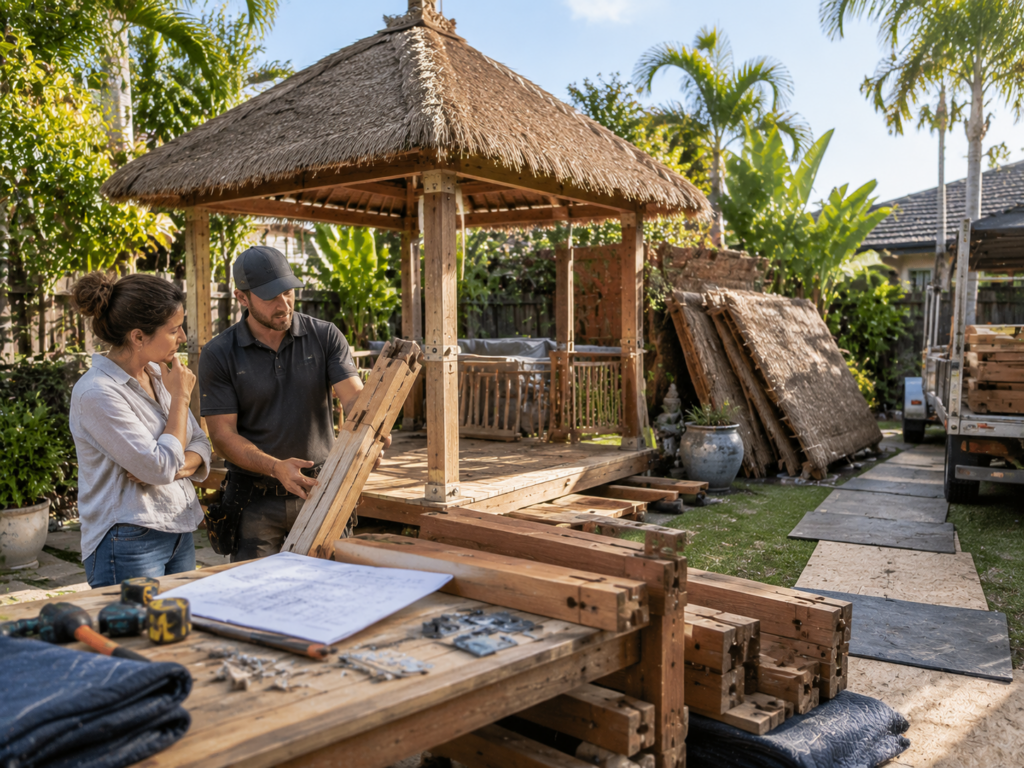
Yes. DIY Bali hut kits are usually easier to take apart because they’re designed to bolt together during installation. Many kits even have numbered poles and pre-drilled beams. This makes each part easier to identify when it’s time to rebuild the hut.

Are DIY Kit Bali Huts Easier to Relocate?

That design also makes the process similar across different kit sizes. For instance, you can dismantle a 3m, 4m, or 5m Bali hut using the same basic method. Plenty of people manage it over a long weekend with two mates and a ladder (ask anyone who has tried it in February). Custom-made frames rarely give you that.

Remember that the fixings still need a careful check before you start. Bolts can rust or seize over time, especially if a DIY Bali hut has been left unsealed. And if the bolts are damaged, removing them can take longer, and some may need replacing before the frame goes back up.

Thatching Damage Often Means the Thatched Roof Cannot Be Reused

Thatch can be difficult to move without damaging it. As reed gets older, it dries out and becomes less flexible.

Alang alang (the grass used for thatching) can have the same problem, while synthetic thatch usually handles removal and transport better. This makes the roof’s age and material important when you’re deciding if it can be reused.

Now, there’s a good reason to spend on the roof rather than skip it. A thick thatched roof provides insulation and can keep the shaded area cooler than the surrounding lawn on a hot afternoon. If the existing thatch can’t survive the move, replacing it can help restore that comfort.

Supplier catalogues do not help either. You may see terms such as African thatch, Cape reed, Bali thatch, and DIY Bali thatch. Here, you need to compare the material, quality, and roof size instead of relying on the product name. Budget for a fresh roof on any hut older than eight years and treat a reusable one as a bonus.

The frame can create similar confusion when you’re looking for replacement parts. One catalogue might list a Balinese Gazebo, the next files Balinese gazebos under gazebos bali, and a third sells an African gazebo beside its African huts.

Ignore the spelling (even on the site that labels its page “Balinese gazebos”) and check whether the African hut in the photo is the same frame you already own.

Relocation Costs for Bali Huts: Comparing DIY Removal, Professional Help, and a New Build

Once you’ve checked the hut’s condition, the next question is cost. Compare your options early, because relocating an old hut can cost more than buying a new one. The final price depends on labour, machinery hire, and whether the existing thatch needs replacing.

The table below sets the three realistic paths side by side.

OptionTypical CostTime NeededRisk of Damage
DIY removalLowest, tools and a trailer hire1 to 2 weekendsHigh if the frame or thatch is brittle
Professional relocationMid-range, crew labour and machinery2 to 4 daysLow, handled by a trained crew
Buying newHighest, full new structure1 to 2 weeks lead timeNone, fresh materials throughout

Truth is, any backyard structure relocation follows the same maths. A new build hands you a fresh living space with no hidden rot in it, and that certainty is part of what you are paying for.

Our rule of thumb: once a quote passes roughly 70% of a new build, the new hut wins. A tight budget with a solid frame still favours doing the removal yourself.

Choosing a Professional Installer for a Safe Bali Hut Move

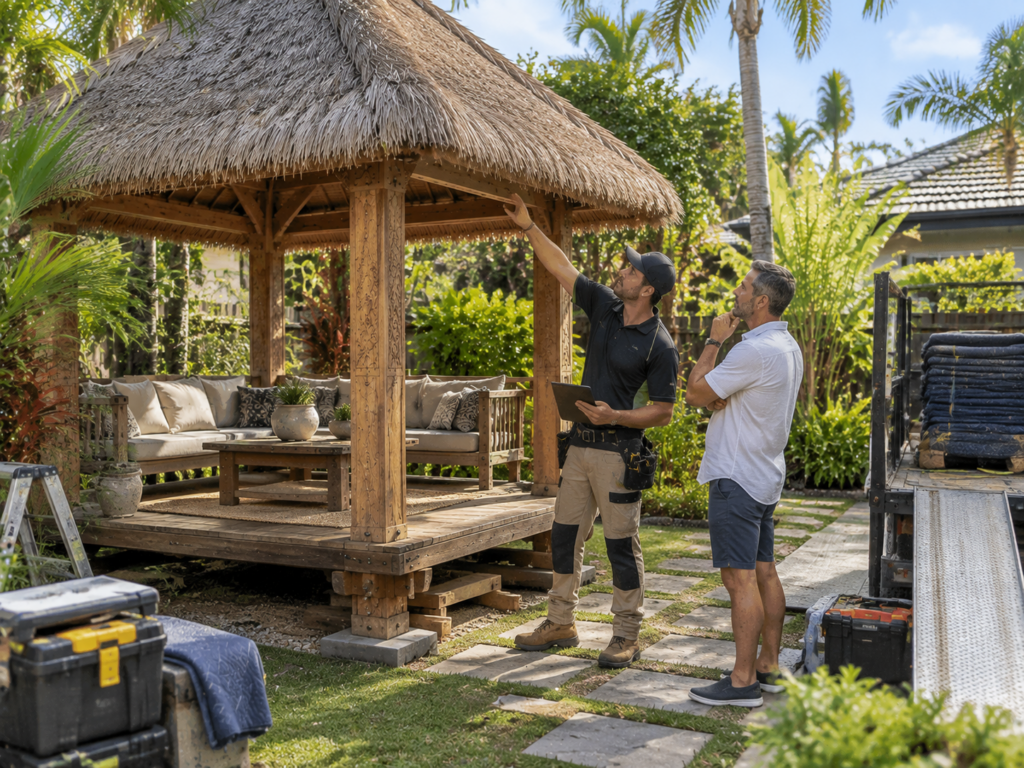
Once you know the costs, the next step is finding an installer with the right experience. Ask how many Bali huts they’ve relocated, rather than how many they’ve built. A new installation and a relocation require different skills, especially when older poles and other materials may be weaker.

Choosing a Professional Installer for a Safe Bali Hut Move

That experience is important during both parts of the job. So look for one team that can dismantle the hut, transport it, and rebuild it on the new pad. Having one crew handle the full job will give you one point of contact if something gets damaged. They may also be able to install features such as thatch gazebos, bamboo panels, screens, and water features while they’re working on the yard.

More importantly, before booking the crew, check that they have suitable insurance. Ask to see a certificate of currency rather than accepting a verbal promise. A hut coming down beside a pool fence or a neighbour’s roof is a genuine risk (one dropped beam costs more than the whole move). That’s why you should ask to see the installer’s insurance certificate before booking the job.

Honestly, the quote itself tells you most of what you need. It should separate the costs for dismantling, transport, new footings, and any replacement thatch. A single lump sum with no breakdown is the clearest red flag in this trade.

Get Expert Help to Relocate Your Bali Hut

A relocated hut can carry your outdoor living area to a new address, but only when the frame and the roof both pass inspection. Every other decision in the job follows that one result. Bali huts (or Balinese huts) are no harder to move than any other timber structure once you know what you are working with.

So book the inspection before you book the truck. A week of checking can save you a fortnight of rebuilding.

Georgia Wiseman builds, relocates, and re-thatches Bali huts for homeowners right across Australia. Contact us to arrange a free quote and get a straight answer on whether your hut is worth moving.

Read More